
Market oriented strategic planning is the ongoing process of learning what your market wants, sharing that knowledge across your business, and adjusting your offerings, messaging, and resources in response. In research that measured the concept as a real organizational behavior, one study of 176 firms reported average scores of 4.03 for intelligence gathering, 4.07 for dissemination, and 3.99 for responsiveness, with an overall mean of 4.03, which is a useful reminder that this isn’t just a slogan.
If you run a service business, this usually shows up in a familiar way. You launch a service package, redesign a website, or put time into a campaign that made perfect sense in the conference room, then buyers respond with a shrug. The problem often isn’t effort. It’s that the plan was built around what the business wanted to sell, not around what the market was signaling it wanted to buy.
Table of Contents
- The Moment Most Plans Go Quietly Wrong
- How Strategic Planning Learned to Listen to the Market
- The Three Behaviors That Make It Actually Work
- How It Differs From Product-First and Customer-Centric Planning
- The Six Tasks of a Market Oriented Planning Cycle
- When Listening Too Closely Becomes a Problem
- What This Looks Like Inside a Real Service Business
- Putting It Into Practice Next Quarter
The Moment Most Plans Go Quietly Wrong
A salon owner creates a premium package built around her favorite treatments. It looks polished, the pricing feels right, and the team is trained on it. A few months later, regulars still book the simpler services they already know.
A small accounting firm does something similar. It invests in a website refresh centered on tax planning and advisory, but the actual inquiries keep coming for bookkeeping cleanup and payroll support. The firm didn’t make a bad plan. It made a plan that started from the inside.
The quiet drift most owners miss
People start asking, what is market oriented strategic planning, in practical terms, not academic ones.
Plainly put, it means you stop planning like a chef cooking your favorite meal for yourself and start planning like a host cooking for guests. You pay attention to what people ask for, what they ignore, what competitors are changing, and where buying behavior is shifting. Then you make decisions based on that reality.
Practical rule: If your offer, website, and sales conversations are all saying different things about what customers need, your plan has already drifted.
The important part is that this isn’t a one-time survey or a yearly retreat. It’s an ongoing discipline with three simple motions:
- Learn: Gather signals from customers, prospects, competitors, reviews, sales calls, and day-to-day service delivery.
- Share: Make sure those signals don’t stay trapped with the owner, the salesperson, or the front desk.
- Adjust: Change the offer, message, pricing logic, intake process, or resource allocation based on what you learned.
Why lean teams need this even more
Small service businesses often assume strategic planning is for big companies with planning departments. In reality, lean teams need market-oriented planning more because they have less room for wasted motion.
If you only have a few people handling operations, sales, marketing, and delivery, every wrong assumption costs time twice. First when you build the wrong thing, then again when you fix it. Market-oriented planning helps you catch misalignment earlier, before it turns into a quarter of low-converting leads, confused messaging, or a service line that sounded smart but never fit local demand.
How Strategic Planning Learned to Listen to the Market
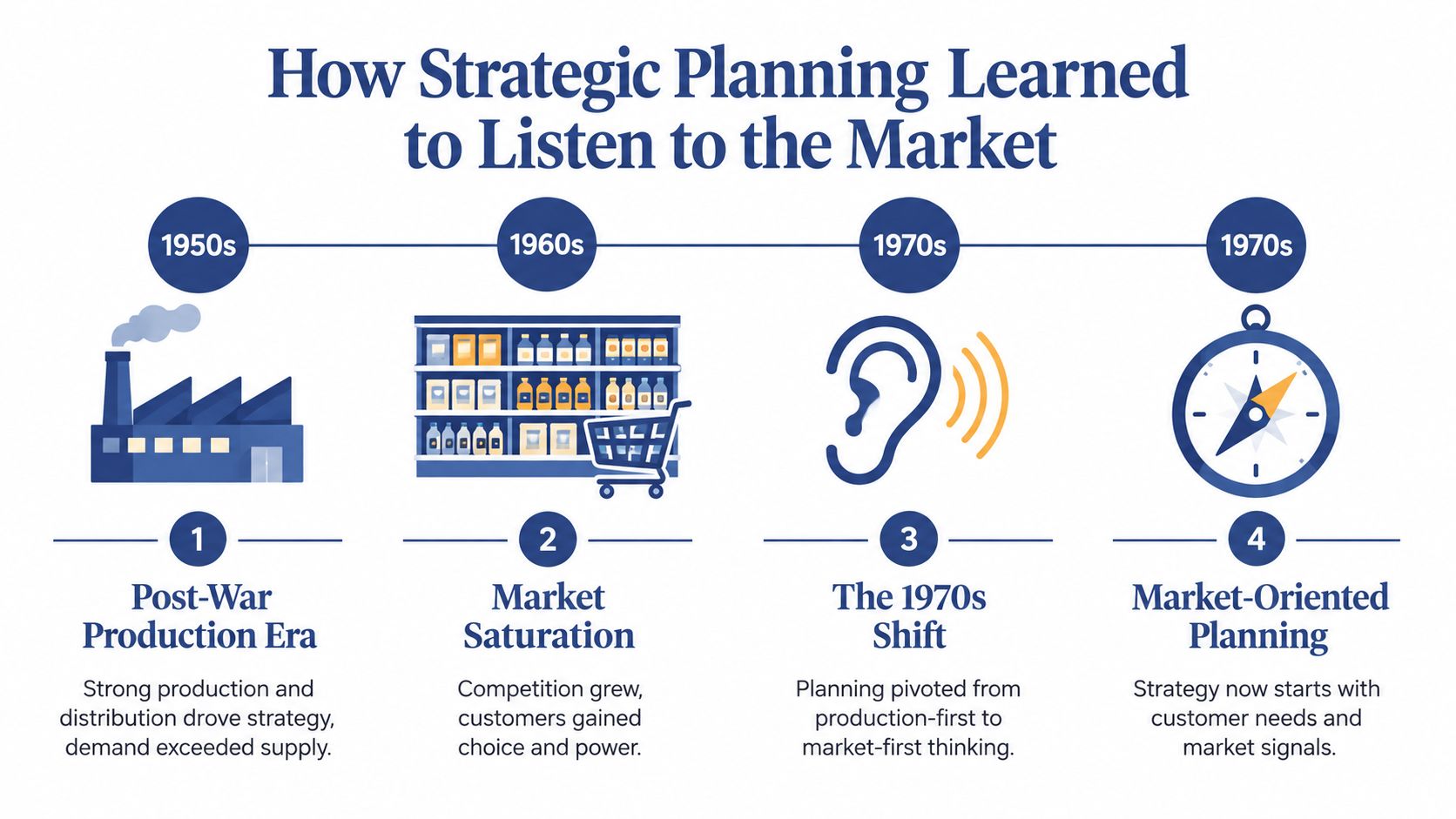
For a long stretch of the post-war business era, companies often planned from the inside out. If you had production strength, distribution reach, and stable demand, strategy could start with what you were already equipped to make and sell. That logic worked well enough when buyers had fewer choices and markets were less crowded.
Then conditions changed. As summarized in this historical overview of market-oriented strategic planning, the shift is commonly traced to the 1970s in the United States, when inflation, energy shocks, stagnation, and deregulation pushed firms away from rigid production scheduling and toward planning that could adapt to changing market opportunities.
From internal efficiency to external awareness
That change mattered because strategy stopped being mainly about internal efficiency and annual budgeting. It became more about scanning the market, tracking customer needs, and staying responsive. By the 1980s, strategic development had spread beyond top executives to operating managers, and the language increasingly shifted from long-range planning to strategic management.
Kotler’s widely cited formulation describes strategic planning as the managerial process of developing and maintaining a viable fit between an organization’s objectives, skills, and resources and its changing market opportunities. That idea still holds up because it captures the basic job of strategy. Find the fit, then keep refitting as conditions change.
For service businesses, that sounds a lot like reality. A website, a sales process, a social content plan, and a service package all need to align with what buyers are looking for now, not what worked two years ago. A useful companion to that kind of thinking is customer journey mapping for growing businesses, because it helps teams notice where buyer expectations shift across touchpoints.
The idea became measurable
A major milestone came in 1990, when Kohli and Jaworski defined market orientation as organization-wide generation of market intelligence about current and future customer needs, dissemination of that intelligence across departments, and organization-wide responsiveness to it. That definition gave managers something more concrete than “be customer focused.” It turned the concept into behaviors a team could observe and improve.
Market-oriented planning wasn’t a passing trend. It was a correction to the older habit of building strategy around what the company wanted to push instead of what the market was signaling back.
The Three Behaviors That Make It Actually Work
The academic definition becomes useful when you treat it like a weekly operating rhythm. Market orientation works through three behaviors: intelligence generation, intelligence dissemination, and responsiveness. A practical summary of the concept appears in this explanation of market orientation and its measured dimensions.
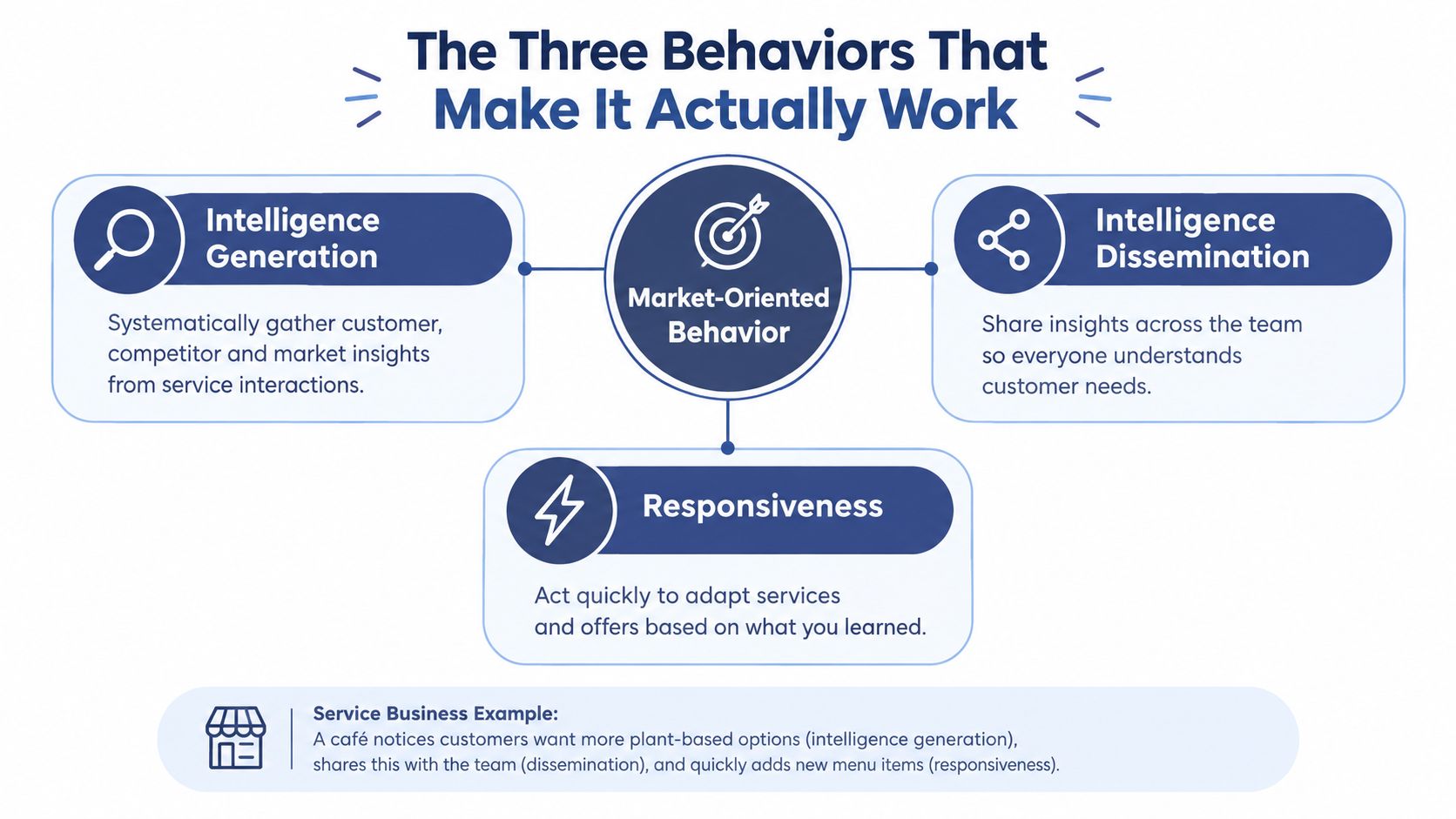
In one study of 176 firms, average scores were 4.03 for intelligence gathering, 4.07 for dissemination, and 3.99 for responsiveness, with an overall mean of 4.03. Another study of 384 respondents reported a market orientation mean of 3.63. Those numbers matter because they show this is a structured capability, not a fuzzy attitude.
Intelligence generation
This is the part where you deliberately collect useful signals.
Say a regional HVAC company is heading into heating season. The owner reviews past customer questions, watches review sites for repeated complaints, checks which financing or maintenance offers competitors are promoting, and listens to what technicians hear in homes. That’s intelligence generation. It’s not glamorous, but it keeps planning grounded.
A fuller academic framing in this research paper on market-oriented strategic planning explains the concept as a continuous sensing-and-adaptation loop rather than a static budgeting exercise.
Intelligence dissemination
Collected insight is worthless if it stays in one inbox.
A boutique marketing agency might gather repeated client feedback about confusion around service scope. If only the account lead knows that, nothing changes. If the agency shares the pattern in a weekly Slack thread and discusses it in a monthly review, strategy, copywriting, design, and client service can all react together.
Here’s a short video that helps visualize how market-oriented behavior functions across a business.
Responsiveness
Many teams stall. They gather insight, maybe even discuss it, but they don’t make a decision.
A law firm notices that prospects repeatedly ask the same pricing question during intake. A responsive move might include rewriting the website copy, adjusting the consultation workflow, training intake staff with better language, and clarifying what’s included in each service tier.
- Generation without sharing creates silos.
- Sharing without action creates meeting notes.
- Action without evidence creates guesswork.
Together, the three behaviors form a loop. Listen, circulate, respond, then listen again.
How It Differs From Product-First and Customer-Centric Planning
A lot of confusion comes from the fact that market-oriented planning sounds close to two other ideas. It overlaps with them, but it isn’t the same.
Product-first starts inside the business
Product-first planning begins with internal capability. A bakery perfects a specialty cake recipe, builds a launch around it, and only later finds out that nearby buyers mostly want simpler celebration cakes with faster turnaround.
That approach can work when the market is obvious or demand is already proven. It breaks down when a business falls in love with its own offering before checking whether the surrounding market shares the enthusiasm.
Customer-centric can still be too narrow
Customer-centric thinking is better, but it can still miss the strategic layer. A freelancer may deliver excellent service, keep clients happy, and customize every engagement, yet drift between unrelated service lines because there’s no structured view of segments, competitors, or positioning.
The issue isn’t that customer-centric planning is wrong. It’s that it often focuses on individual relationships rather than a coordinated business response to market conditions.
The comparison in plain terms
| Dimension | Product-First Planning | Customer-Centric Planning | Market Oriented Strategic Planning |
|---|---|---|---|
| Starting point | Internal capabilities and existing offers | Individual customer needs and satisfaction | Market intelligence across customers, competitors, and conditions |
| Main question | What can we build or sell? | How do we serve this customer well? | Where is demand moving, and how should the business adapt? |
| Insight source | Internal ideas, operations, expertise | Customer feedback and service experience | Structured signals gathered and shared across the business |
| Coordination | Often limited to product or leadership | Often concentrated in service or account management | Cross-functional by design |
| Success measure | Launching and delivering the offer | Satisfying clients and retaining relationships | Adjusting offers, messaging, and resources to fit the market |
Customer-centric planning helps you care. Market-oriented planning helps you coordinate.
The difference matters because service firms rarely fail from lack of effort. They fail when their website, sales process, pricing, and delivery evolve at different speeds.
The Six Tasks of a Market Oriented Planning Cycle
Classic strategic planning frameworks describe six core tasks such as defining mission, analyzing the external environment, examining internal strengths and weaknesses, formulating goals, crafting strategy, and implementing and controlling the plan. Cornell teaching material also presents an eight-step version that adds program formulation, implementation, feedback, and control, as noted in these planning notes.
For a lean service team, I’d translate that into a planning cycle you can run on the calendar.
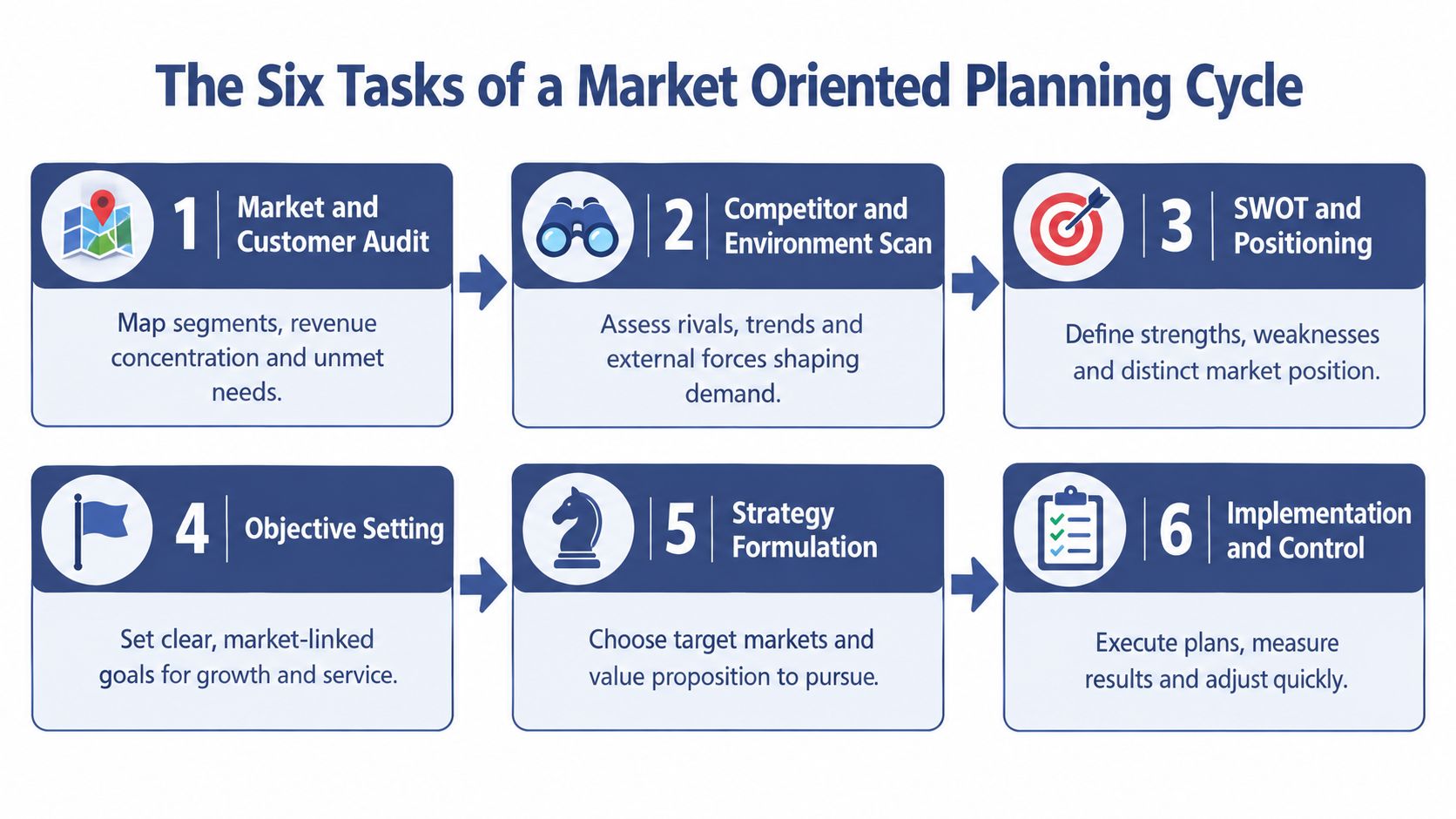
The six working tasks
Run a market and customer audit
Review your current segments, where revenue is concentrated, which inquiries are rising, and where buyers still seem confused. Pull signals from contact forms, sales calls, reviews, direct messages, and repeat questions.Scan competitors and substitutes
Look beyond obvious rivals. A bookkeeping firm may compete with another firm, a software platform, or an internal hire. A good scan looks at offer structure, messaging, onboarding, and what buyers now expect as standard.Synthesize the insight
Don’t build a wish list with twenty findings. Narrow everything into two or three strategic priorities. That discipline is what keeps planning useful.
A plan becomes manageable when the team can point to a small set of market truths and say, “These are the signals we’re responding to this quarter.”
Refine positioning and offers
Rewrite the value proposition, service packaging, pricing logic, and core deliverables so they reflect the priorities you identified. If you need examples from another category, this handbook for small CPG brands is a helpful resource because it shows how clearer positioning supports better go-to-market decisions, even if your business isn’t in packaged goods.Deploy the plan into operations
Assign owners, meeting rhythms, budgets, and simple decision rules. If marketing hears one thing and delivery does another, the strategy never reaches the client experience. This is also where firms often benefit from outside support. For example, Blu Dragonfly LLC works on websites, branding, content structure, and marketing coordination, which are the places strategy often needs to become visible. A useful starting point is understanding the importance of data in marketing.Review and adjust on a cadence
Put a quarterly review on the calendar, with monthly checkpoints. The point isn’t to produce more slides. It’s to spot shifts early enough to act while the quarter is still recoverable.
What goes on the actual calendar
- Weekly: Capture frontline signals and recurring objections.
- Monthly: Share patterns across the team and decide what needs action.
- Quarterly: Revisit priorities, offers, and channel emphasis.
When Listening Too Closely Becomes a Problem
Most advice on market orientation treats more listening as automatically better. That’s too simple. Recent academic discussion has pointed out an important tension in market orientation: businesses have to balance responsiveness with strategic consistency and innovation, as discussed in this review of market orientation tradeoffs.
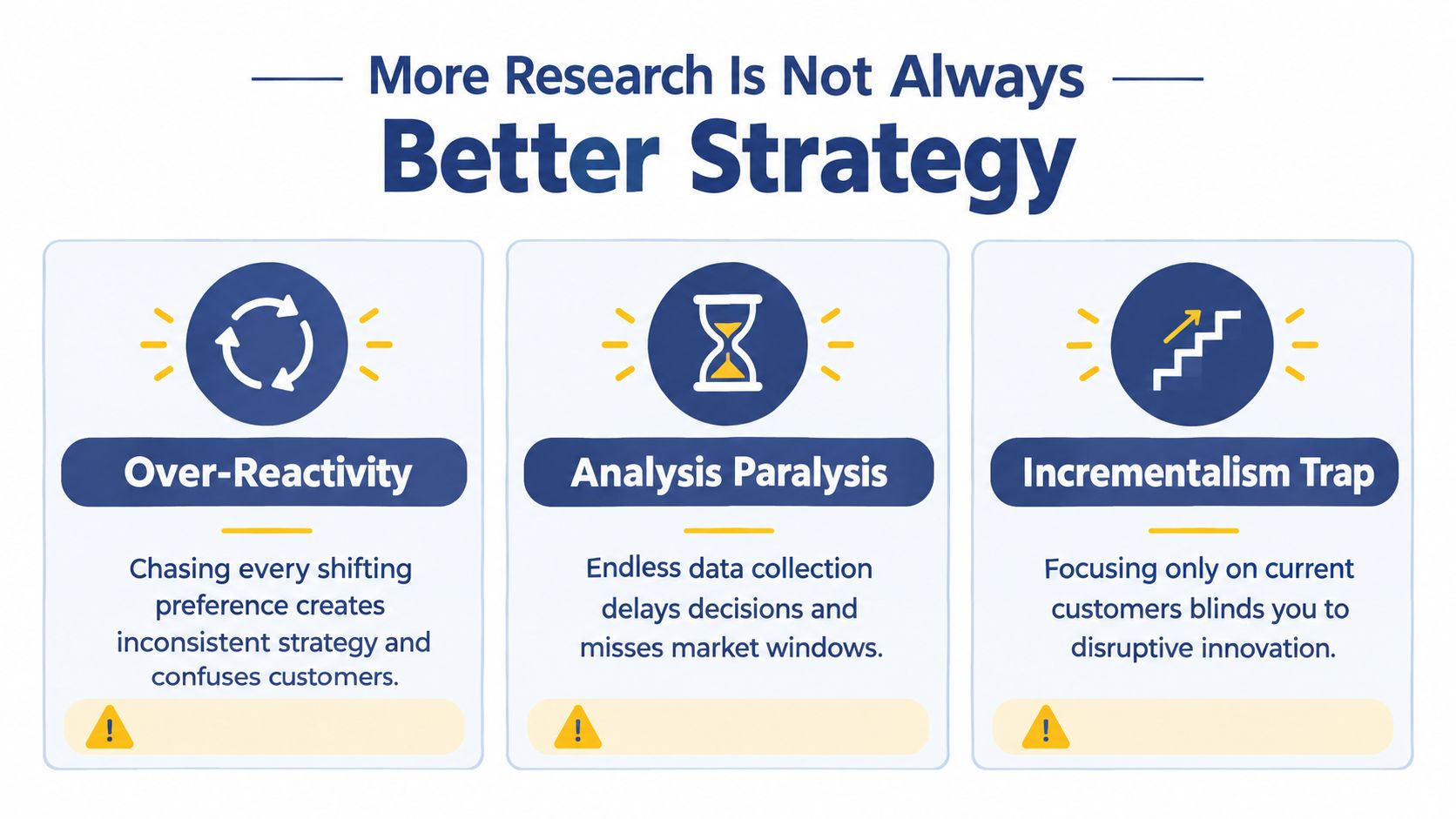
Three ways good listening turns into bad strategy
The first problem is over-reactivity. A business hears every request and keeps reshaping the offer. Soon the website is crowded, the service menu is messy, and the team can’t explain the core value clearly.
The second is customer myopia. If you only optimize for current buyers, you can miss adjacent segments or non-customers whose needs are starting to reshape the market.
The third is innovation drag. Customers are good at describing current frustrations. They’re not always good at imagining a better delivery model, a smarter service structure, or a new category altogether.
The balance that works
A service business can avoid these traps without becoming stubborn.
- Set listening windows: Gather and review signals on a schedule instead of rewriting strategy every time one prospect says something new.
- Protect exploratory capacity: Reserve some time for testing new offers, new messaging angles, or new delivery formats.
- Use response criteria: Ask whether a signal is repeated, commercially meaningful, and aligned with your long-term position before changing the plan.
Listening is useful. Leading is necessary. Good strategy holds both at the same time.
What This Looks Like Inside a Real Service Business
The concept becomes clearer when you watch it happen in ordinary business decisions.
A DFW boutique adjusts to real local demand
A boutique clothing store in the Dallas-Fort Worth area starts noticing a pattern. Stylists hear more shoppers asking for event-specific outfits instead of broad seasonal shopping. Instagram saves cluster around pieces tagged for brunch, weddings, and work events. Certain items move slowly unless staff explain the occasion they fit.
That store doesn’t need a giant strategy deck. It needs to gather the signals, share them, and change the plan. In the next quarterly planning session, the team shifts its buy toward occasion-based demand, retags website categories around real use cases, and rewrites email subject lines to match what regulars are planning for.
That’s market-oriented planning in motion. The inventory plan, the site structure, and the messaging all move together.
A Texas B2B firm hears the real complaint behind the complaint
Now take a Texas-based B2B services firm serving mid-market manufacturers. Procurement contacts keep pushing on one issue during renewal and onboarding conversations. They aren’t just unhappy with delivery speed. They’re frustrated that reporting feels delayed and hard to interpret.
The useful signal isn’t “customers want better service.” That’s too vague to act on. The useful signal is that buyers want clearer operational visibility.
So the firm brings the pattern to leadership, delivery, and engineering. The team retools service tiers to include weekly dashboards, updates sales language to feature reporting transparency, and adjusts account kickoff materials so expectations are visible earlier.
Same logic, different categories
These two businesses sell very different things, but the operating pattern is the same:
- They gather live signals from conversations, behavior, and demand patterns.
- They distribute those signals so decisions don’t stay siloed.
- They make visible changes to offers, website structure, content, or delivery.
A lot of website and branding work should happen at exactly this point. If the market has shifted but the site architecture, service pages, social content, or intake flow still reflect old assumptions, buyers feel the mismatch immediately. That’s why market-oriented planning matters so much for service firms. It doesn’t stay in the strategy file. It shows up in what prospects read, ask, book, and trust.
Putting It Into Practice Next Quarter
If you want a usable version of this, don’t start by rewriting your whole business plan. Start by building a ninety-day rhythm.
Four moves to start on Monday
Choose one segment to study more
Not all customers at once. Pick one segment that matters this quarter and listen harder there.Create a weekly signal routine
Pull questions from calls, website forms, reviews, DMs, proposals, and close-lost notes. Keep it simple enough that the habit sticks.Hold one monthly cross-functional review
Bring the owner, operations lead, sales contact, and whoever handles marketing or web updates into the same conversation. If you need practical ideas for getting those messages in front of people, this guide on how to advertise your business can help connect planning to visible outreach.Pick three responsive actions
One might be about pricing, one about service scope, and one about content or website messaging. The point is to make your listening visible in the business.
A short working checklist
- Is the segment clear
- Are signals being captured weekly
- Does the whole team see the same patterns
- Have you chosen a small number of changes
- Is there a review date already on the calendar
Market oriented strategic planning isn’t about writing longer plans. It’s about making your plan easier to correct while there’s still time to improve the quarter.
If your business needs help turning market insight into a clearer website, stronger brand positioning, or more coordinated marketing execution, Blu Dragonfly LLC offers collaborative support across WordPress web design and development, branding, marketing strategy, social media, media production, graphic design, and website accessibility. Visit Blu Dragonfly LLC to see how the team helps service businesses turn scattered signals into a more aligned digital presence.