
by Tech Support | | Case Studies
At a glance:
- Client: ATEK Distribution, a Minneapolis, Minnesota electrical equipment distributor that serves contractors, engineers and government buyers nationwide.
- Results: in six months of SEO work by Blu Dragonfly, ATEK’s organic Google impressions grew 4.1× and organic clicks almost doubled. Clicks from people who didn’t search the company name grew more than 11×.
- Channel: every number comes from organic search. No paid ads were involved.
Results at a glance
| Organic search (Google Search Console) | 6 months before | Latest 6 months | Change |
|---|
| Impressions (times ATEK appeared in Google) | 34,642 | 142,028 | +310% (4.1×) |
| Clicks (visits from Google) | 673 | 1,291 | +92% |
| Average position | 12.0 | 9.4 | 2.6 places higher, now on page one |
| Non-brand clicks (searches without “ATEK”)* | 16 | 186 | 11.6× |
| Non-brand impressions* | 7,952 | 39,968 | 5× |
| Pages earning clicks | 70 | 81 | +11 pages |
*Non-brand figures come from the top 1,000 queries Google reports for each period.
The challenge
Before the project, almost all of ATEK’s search traffic came from people who already knew the company and searched “ATEK Distribution”. Contractors and buyers searching for the products and answers ATEK can supply rarely found the site. In the six months before, non-brand searches brought only 16 clicks.
What we did
- Expert content that answers real trade questions. We wrote practical guides for electricians, engineers and buyers. Topics include WAGO vs wire nuts, whether WAGO connectors are code-approved, types of fuses, industrial fuse selection, EMT vs rigid conduit, and 2026 NEC changes for Minnesota, EV charging and arc-flash labeling.
- Stronger commercial pages. We built or rebuilt 10 pages, including GSA contract, SDVOSB electrical distributor, Minneapolis supply distributor, circuit breakers, and a Solutions hub with five child pages. Two competing Minneapolis pages were merged into one.
- Technical SEO.
- FAQ structured data on key pages
- six redirect faults fixed
- a clearer mobile menu
- a Solutions menu that surfaces pages that were only linked in the footer
- accurate business details in the site’s structured data
- Accuracy and trust. Pages now state clearly that ATEK is a supplier, not an installer, so buyers know exactly what to expect.
- Authority. We added relevant directory listings, including Thomasnet and BBB, and a University of Minnesota link.
Standout result: one guide, 19× more clicks
ATEK’s WAGO vs wire nuts guide grew from 24 clicks and 5,714 impressions to 465 clicks and 65,470 impressions, at an average position of 5.3. It is now the site’s top organic page, ahead of the homepage.
Other new guides now rank at average positions of about 4–7:
| Guide | Average position (latest 6 months) |
|---|
| Are WAGO connectors code-approved | 4.4 |
| 2026 NEC EV charging requirements | 5.3 |
| Industrial fuse selection guide | 5.5 |
| Minnesota 2026 NEC changes | 6.2 |
Momentum is still building
The most recent quarter (Jul–Sep 2026) brought 807 clicks and 88,392 impressions. That one quarter beat the previous six months combined on both measures.
What’s next
The next phase turns this visibility into more visits and quote requests: sharper search titles and descriptions on high-impression pages, and clearer paths from technical guides to product and quote pages.
Want results like these? Blu Dragonfly offers SEO services for B2B and local businesses. Book a free consultation.
All figures are organic Google Search results from ATEK’s Search Console. Results depend on each business’s market, competition and search demand.

by Tech Support | | SEO
Most small businesses should expect to pay $500–$2,500 per month for legitimate SEO services in 2026, or $1,000–$7,500 for one-time project work like a site audit and optimization. Hourly SEO consulting typically runs $75–$200/hour. Anything dramatically below these ranges is usually automated, outsourced, or actively harmful — and anything above them should come with a very clear plan and reporting.
I’m Cristie Remmel Campo, a Dallas web designer who builds SEO into every site I launch — and who regularly meets business owners burned by bad SEO contracts. Here’s what the market really charges, what you get at each price level, and the red flags that should end a sales call immediately.
SEO Pricing at a Glance (2026)
| Pricing model | Typical range | Best for |
|---|
| Monthly retainer | $500–$2,500/mo (small business) · $2,500–$10,000/mo (competitive markets) | Ongoing growth |
| One-time project | $1,000–$7,500 | Site audit + fixes, migrations, new-site SEO setup |
| Hourly consulting | $75–$200/hr | Specific questions, second opinions |
| “Cheap SEO” packages | $99–$300/mo | Nobody — see below |
What You Actually Get at Each Price Level
Under ~$500/month: be careful
At this price, real human hours are minimal. Typical deliverables are automated reports, mass-produced “directory submissions,” and thin AI-spun blog posts. Some cheap providers still build spammy links that can get a site penalized. If a monthly fee is less than a few hours of skilled labor, ask exactly who is doing the work and what they will deliver each month.
$500–$1,500/month: solid small-business SEO
This is the realistic entry point for genuine work: technical fixes, on-page optimization, Google Business Profile management, content optimization, and monthly reporting. For a local business in a moderately competitive market, this level — done consistently for 6–12 months — is often enough to reach the local map pack and page one for service keywords.
$1,500–$5,000/month: competitive markets
Legal, medical, real estate, and competitive metro keywords (think “web design Dallas”) require ongoing content production, digital PR, and link earning. This is where established agencies and senior freelancers operate.
One-time projects: often the smartest first purchase
Before committing to any retainer, a one-time technical audit and cleanup ($1,000–$3,000) frequently delivers the biggest single jump — fixing broken titles, missing schema, slow pages, and indexation problems. Many businesses ranking on page 5 aren’t losing to competitors’ content; they’re losing to their own technical issues.
6 Red Flags That Should End the Call
- “We guarantee #1 rankings.” Nobody can guarantee rankings — Google says so explicitly. Guarantees are the oldest scam in SEO.
- They won’t tell you what they’ll actually do each month. “Proprietary methods” usually means “nothing.”
- They own your work. If content, links, or even your Google Business Profile access disappears when you cancel, walk away.
- Instant results promises. Legitimate SEO shows movement in 2–4 months, meaningful results in 6–12.
- No reporting, or reports full of vanity metrics. You want rankings, clicks, and leads — not “hours worked.”
- They never mention your website’s quality. SEO on a slow, dated, untrustworthy site is wasted money; sometimes the honest answer is “fix the website first.”
When You Can Skip Paid SEO Entirely
Not every business needs a retainer. You can likely handle it yourself if: you’re in a low-competition local niche, you have time to write one genuinely helpful article per month, and your website is technically sound. The free essentials — a complete Google Business Profile, consistent reviews, correct titles and descriptions, and fast mobile pages — outperform many paid packages.
Where money is well spent: the initial technical setup, a professional site structure, and content strategy. Where it’s often wasted: vague ongoing retainers with no defined deliverables.
So, How Much Should You Pay?
A simple rule: your monthly SEO budget should be justified by the value of one new customer. If one client is worth $2,000 to you, an $800/month investment that produces a few extra clients per quarter pays for itself. If one sale is worth $30, aggressive paid SEO rarely makes sense — focus on the free fundamentals and a technically clean website instead.
Frequently Asked Questions
How much does SEO cost per month for a small business?
Most legitimate small-business SEO retainers cost $500–$2,500 per month in 2026, depending on competition and how much content is included.
Is cheap $99/month SEO worth it?
Almost never. At that price the work is automated or mass-outsourced, and low-quality link building can actually harm your rankings.
How long before SEO shows results?
Expect early movement in 2–4 months and meaningful traffic changes in 6–12 months. Anyone promising faster guaranteed results is a red flag.
Should I pay for SEO or a better website first?
Website first. SEO drives visitors, but a slow or untrustworthy site won’t convert them — and site quality itself is a ranking factor.
Before You Sign Any SEO Contract
Make sure your website itself isn’t the problem. Blu Dragonfly builds SEO-ready websites in Dallas with clean technical foundations included, and offers SEO services in Dallas with a fixed written scope — book a free call and we’ll tell you honestly whether you need SEO services or just a better site.
Book a Free Call
See also: Dallas SEO services · technical SEO audits · graphic design services · what freelancers charge for design

by Tech Support | | Design Pricing
Most freelance graphic designers charge between $25 and $150 per hour, with experienced professionals typically landing in the $50–$100/hour range. For fixed projects, expect roughly $300–$2,500 for a logo, $1,000–$5,000 for a full brand identity, and $150–$500 for a social media template pack. Rates vary with experience, location, and how much strategy is included — not just the design file itself.
I’m Cristie Remmel Campo, a freelance graphic and web designer in Dallas, Texas, and in this guide I’ll break down what freelance designers actually charge, why the range is so wide, and how to tell whether a quote is fair — from the designer’s side of the table.
Freelance Graphic Design Rates at a Glance
| Project type | Typical 2026 range | What affects the price |
|---|
| Hourly rate | $25–$150/hr | Experience, specialty, demand |
| Logo design | $300–$2,500 | Concepts included, revisions, research |
| Full brand identity kit | $1,000–$5,000+ | Logo + colors, fonts, brand guide |
| Social media template pack | $150–$500 | Number of templates, platforms |
| Business card / flyer | $100–$400 | Print prep, copywriting |
| Monthly retainer | $500–$3,000/mo | Volume and turnaround speed |
These are U.S. market ranges. Beginners on marketplaces like Fiverr may charge far less; senior brand specialists charge far more.
The Three Ways Freelance Designers Price Work
1. Hourly rates
Hourly pricing is common for ongoing or undefined work. A designer with 1–2 years of experience might charge $25–$50/hour; a designer with 5–10 years and a strong portfolio usually charges $60–$120/hour. The catch for clients: an hourly quote tells you nothing about the final bill until the project is done.
2. Per-project (flat) pricing
Most experienced freelancers, myself included, prefer flat pricing: you know the exact cost before work starts. A flat price isn’t just “hours × rate” — it includes discovery, concept development, revisions, and file preparation. That’s why a $900 logo from an experienced designer can be a better deal than a $300 logo that needs redoing in a year.
3. Monthly retainers
If you need graphics every month — social posts, ads, email headers — a retainer usually beats one-off pricing. Typical small-business retainers run $500–$1,500/month for a set number of deliverables, with priority turnaround.
Why Is the Price Range So Wide?
Five things move a designer’s rate more than anything else:
- Experience and portfolio. A designer who has branded 100 businesses charges more because their first concept is usually right.
- Strategy vs. decoration. Some designers make things look nice; others research your market and design to position you against competitors. Strategy costs more and earns more.
- What’s included. One concept and one revision is cheap. Three concepts, unlimited revisions, all file formats, and a brand guide is not — and shouldn’t be.
- Rights and files. Full ownership plus source files (AI/SVG) should always be included at professional rates. If it isn’t, that “cheap” quote is renting, not buying.
- Location and demand. Designers in major metros like Dallas, Austin, or NYC typically charge more than the national average — but remote work has narrowed this gap.
Red Flags in a Design Quote (From Someone Who Sees the Cleanups)
A large share of my projects are fixing work clients already paid for once. Watch for:
- No contract or scope document. “We’ll figure it out as we go” means the budget will too.
- No mention of file formats or ownership. You need vector files and full rights, in writing.
- A logo in 24 hours for $50. That’s usually a template or AI output someone else can buy tomorrow.
- Unlimited everything for a rock-bottom price. Unsustainable pricing produces rushed work or a vanished designer.
What Should a Small Business Actually Budget?
For a new small business that needs to look credible, a realistic 2026 starting budget is $1,500–$3,500 for a logo, basic brand kit, and social templates from an experienced freelancer. That’s typically a third to half of what a mid-size agency quotes for the same deliverables — because with a freelancer you’re paying for design, not overhead.
Frequently Asked Questions
What is the average hourly rate for a freelance graphic designer?
Most U.S. freelance graphic designers charge between $25 and $150 per hour, with experienced designers averaging roughly $50–$100 per hour in 2026.
Is it cheaper to hire a freelancer or an agency?
Freelancers are usually 30–60% less expensive than agencies for the same deliverables, because you’re not funding account managers and office overhead. Agencies make more sense for very large, multi-team campaigns.
How much should a small business pay for a logo?
From an experienced freelancer, a professional custom logo typically costs $500–$2,500 including revisions, all file formats, and full ownership.
Should I pay hourly or per project?
Per-project pricing is safer for most clients: you know the total cost upfront and the designer is motivated by results, not hours.
Want a Fixed Quote Instead of a Guess?
I offer transparent, flat-rate graphic design services in Dallas — book a free call and you’ll get an exact price before any work begins.
Book a Free Call
See also: web design services · graphic design services · pricing guide · about Cristie
by Tech Support | | Brand Identity, Business, Business Strategy, Marketing Strategies
Is Your Website Silently Repelling Customers?
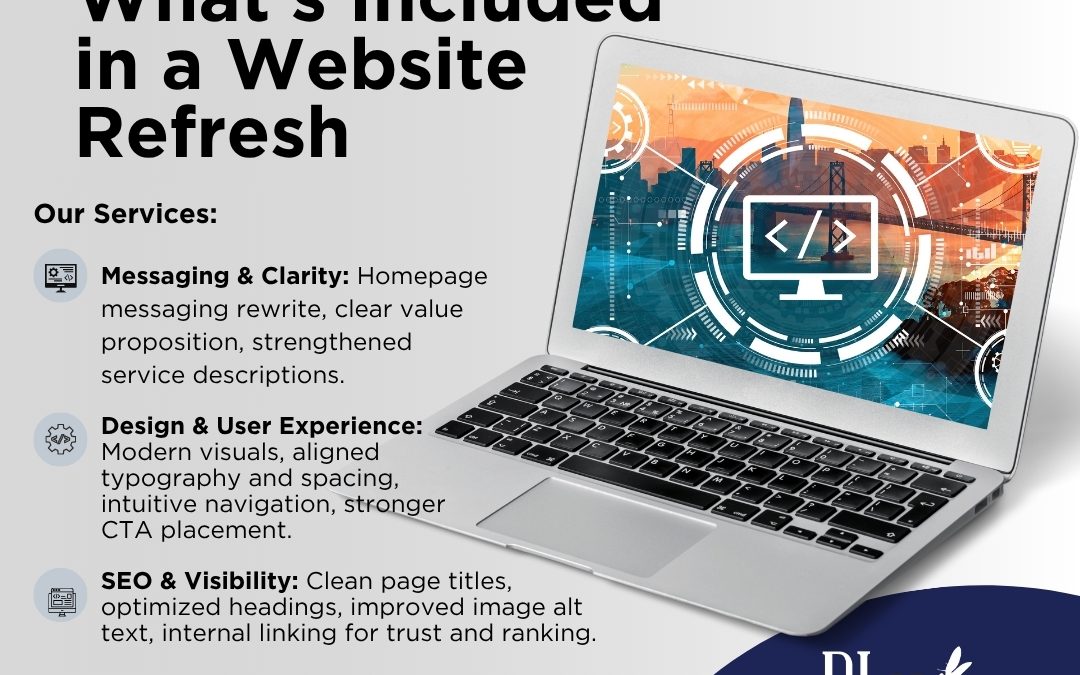
A website refresh is often needed when a site quietly repels customers instead of converting them.
Most business owners don’t realize when their website is pushing potential clients away. There are no alerts, error messages, or obvious warnings — just fewer inquiries, shorter visits, and a slow, silent drop in engagement.
And here’s the hard truth:
People won’t tell you when your website feels confusing, slow, or unclear. They simply leave.
They click away. They forget you. They choose someone else.
Not because your business lacks value — but because your website didn’t communicate that value fast enough.
Website Refresh Warning Signs Most Businesses Miss
If your website isn’t producing consistent leads, chances are it’s suffering from one (or more) of these silent deal-breakers. These issues don’t announce themselves — they quietly create friction, and friction kills conversion.
1. Slow Loading Speed
If your site takes more than 3 seconds to load, visitors bounce.
Not because they’re impatient — but because the human brain subconsciously associates slow websites with low trust.
According to Google research, over 50% of users abandon a site that takes longer than three seconds to load. A website refresh focuses on improving performance so visitors stay long enough to understand your value.
2. Poor Mobile Experience
More than 70% of website traffic comes from mobile devices.
If your website: – Is hard to navigate on a phone – Has text that’s too small to read – Shifts images and buttons while loading
Visitors disconnect instantly.
A modern website refresh prioritizes mobile usability, ensuring your site feels effortless to use on any screen size.
3. No Clear Next Step
If your website doesn’t clearly tell visitors what to do next, they won’t take action.
Every page should answer one simple question:
“Where do I go next?”
Whether it’s contacting you, booking a consultation, or downloading a resource — clarity converts. Confusion repels.
If you’re unsure whether your site provides clear direction, Blu Dragonfly can perform a professional website audit to identify gaps and missed opportunities.
Why a Website Refresh Improves Trust and Conversion
When someone lands on your website, they make a decision within seconds — not based on logic, but on perception.
Your site’s speed, layout, and messaging send subconscious signals about: – Credibility – Professionalism – Trustworthiness
A strategic website refresh focuses on: – Removing friction – Clarifying messaging – Improving mobile usability – Guiding visitors toward a clear call to action
This isn’t about redesigning everything from scratch. It’s about aligning your website with how people actually think and behave online.
The Good News
You can check all three major issues — speed, mobile usability, and clarity — in under five minutes.
And if something’s off, it can usually be fixed without rebuilding your entire website.
That’s where a website refresh comes in: refining structure, messaging, and flow so your website works the way it should.
Small, strategic adjustments can lead to: – Longer browsing sessions – Higher inquiry and conversion rates – Visitors feeling confident and comfortable reaching out
Your website doesn’t need to be fancier — just clearer, faster, and aligned with your audience’s expectations.
Website Refresh: Improving Trust and Conversion
A well-executed website refresh builds trust before a visitor ever contacts you.
When your site loads quickly, works seamlessly on mobile, and clearly communicates what you offer, visitors feel reassured — and reassurance leads to action.
Free Resource
📘 Download Our FREE Trust-Building Website Checklist
Learn how to identify hidden issues that may be costing you leads — and how a website refresh can fix them.
👉 Get the Free Checklist
If you suspect your website may be silently repelling customers, a website refresh could be the most effective step you take this year.
What is a website refresh?
A website refresh is the process of improving an existing website’s performance, messaging, usability, and structure without rebuilding it from scratch. The goal is to improve trust, user experience, and conversion rates.
How often should a website refresh be done?
Most businesses benefit from a website refresh every 18–24 months. This ensures the site stays aligned with changing user behavior, mobile standards, and performance expectations.
Is a website refresh better than a full redesign?
In many cases, yes. A website refresh is faster, more cost-effective, and focuses on fixing what’s holding your site back rather than starting over.
Is a website refresh better than a full redesign?
In many cases, yes. A website refresh is faster, more cost-effective, and focuses on fixing what’s holding your site back rather than starting over.
Does a website refresh improve SEO?
Yes. A website refresh improves page speed, mobile usability, content clarity, and internal structure — all of which directly impact SEO and rankings.
Planning a new website or a redesign? Blu Dragonfly designs and builds custom WordPress websites for small businesses — see our web design services in Dallas or book a free consultation.

by Tech Support | | Brand Identity
In the fast-paced world of entrepreneurship, staying ahead of the curve is crucial for success. As we navigate through 2024, several innovative trends have emerged, transforming the business landscape. These trends not only shape how businesses operate but also redefine the way entrepreneurs think, act, and achieve success. Let’s explore some of the most impactful trends that are driving successful business practices today.
1. The Rise of Sustainable Business Models
Sustainability is no longer a buzzword; it’s a business imperative. Consumers are increasingly demanding eco-friendly products and transparent business practices. Entrepreneurs who incorporate sustainability into their business models are reaping significant rewards. This includes adopting green manufacturing processes, utilizing renewable energy sources, and ensuring ethical supply chains. Companies like Patagonia and Tesla have set the benchmark, showing that sustainable practices can lead to profitability and brand loyalty.
2. Leveraging Artificial Intelligence and Automation
Artificial Intelligence (AI) and automation are revolutionizing industries by streamlining operations and enhancing customer experiences. Entrepreneurs are harnessing these technologies to gain competitive advantages. AI-driven analytics provide valuable insights into consumer behavior, enabling businesses to personalize marketing strategies and improve customer engagement. Automation, on the other hand, is optimizing workflows, reducing costs, and increasing efficiency. Startups leveraging AI for predictive analytics, chatbots, and automated customer service are setting new standards in customer satisfaction.
3. Remote Work and Flexible Workspaces
The COVID-19 pandemic accelerated the adoption of remote work, and it’s clear this trend is here to stay. Entrepreneurs are increasingly recognizing the benefits of remote and hybrid work models, such as reduced overhead costs and access to a global talent pool. Companies like Zoom and Slack have thrived by providing essential tools for remote collaboration. Creating flexible work environments not only enhances productivity but also improves employee satisfaction, leading to better retention rates.
4. E-Commerce and Digital Transformation
The e-commerce boom shows no signs of slowing down. With more consumers preferring online shopping, businesses must adapt to this digital shift. Entrepreneurs are investing in robust e-commerce platforms and utilizing social media for targeted marketing. Additionally, integrating technologies like augmented reality (AR) can enhance the online shopping experience, giving consumers a tangible sense of products. Successful e-commerce entrepreneurs are those who continuously innovate and offer seamless, personalized shopping experiences.
5. Data-Driven Decision Making
Data is the new gold. Entrepreneurs who leverage data analytics are better positioned to make informed decisions and identify market opportunities. From understanding customer preferences to optimizing supply chains, data-driven strategies are crucial. Tools like Google Analytics, Tableau, and various CRM systems provide actionable insights that drive growth and efficiency. By adopting a data-centric approach, entrepreneurs can anticipate trends, mitigate risks, and outperform competitors.
6. Emphasis on Health and Well-Being
The well-being of employees has become a focal point for businesses. Entrepreneurs are increasingly prioritizing mental health initiatives, work-life balance, and wellness programs. This trend not only fosters a positive work culture but also boosts productivity and reduces turnover. Companies that invest in the health and well-being of their workforce are likely to see improved performance and higher employee satisfaction. Programs offering flexible hours, mental health support, and physical fitness opportunities are becoming standard practices.
7. Social Media and Influencer Marketing
Social media continues to be a powerful tool for brand building and customer engagement. Entrepreneurs are capitalizing on platforms like Instagram, TikTok, and LinkedIn to reach their target audiences. Influencer marketing, in particular, has proven to be an effective strategy. Partnering with influencers allows businesses to leverage their followers and create authentic connections with potential customers. Entrepreneurs who skillfully navigate social media trends and build strong online presences are experiencing significant growth.
Conclusion
The entrepreneurial landscape is dynamic, with new trends constantly emerging. By embracing sustainable practices, leveraging AI and automation, adopting flexible work models, focusing on e-commerce, utilizing data-driven strategies, prioritizing health and well-being, and mastering social media marketing, entrepreneurs can ensure their businesses not only survive but thrive. Staying agile and innovative is the key to capitalizing on these trends and achieving long-term success in today’s competitive market.
